ES Futures Trading Hours: Sessions, Breaks, Liquidity
ES futures trading hours in Eastern Time: the Globex session, the daily break, regular hours, when liquidity is best, and how overnight levels are used.
By OrderMap Research4 min read
On this page
The schedule in Eastern Time
E-mini S&P 500 (ES) futures trade on CME Globex nearly 23 hours a day, five days a week. The trading week opens Sunday at 6:00 p.m. Eastern Time and ends Friday at 5:00 p.m. Each day has a 60-minute maintenance break from 5:00 to 6:00 p.m. Nasdaq-100 (NQ) futures and the micro contracts MES and MNQ follow the same schedule.
Holidays shorten or pause sessions, and exchanges adjust schedules from time to time, so treat CME's trading hours page as the authority. The rest of this article is about what the hours mean in practice, because the calendar says when you can trade and not when you should.
The parts of the trading day
| Period (Eastern Time) | Common name | Character |
|---|---|---|
| 6:00 p.m. to about 2:00 a.m. | Asia session | Thinnest liquidity; small ranges unless news hits |
| About 2:00 a.m. to 8:30 a.m. | Europe session | Volume builds as London opens |
| 8:30 a.m. | US data releases | Scheduled reports can move price sharply |
| 9:30 a.m. to 4:00 p.m. | Regular trading hours (RTH) | Most volume; cash stocks and options are open |
| 4:00 p.m. to 5:00 p.m. | Post-close | Liquidity fades quickly into the break |
| 5:00 p.m. to 6:00 p.m. | Daily break | No trading |
The period from 6:00 p.m. to 9:30 a.m. is often called the overnight or Globex session, sometimes abbreviated ETH for extended trading hours. A new trading date begins at the 6:00 p.m. open: Monday's session starts on Sunday evening.
Where the liquidity is
Volume in ES is concentrated in regular hours, with the heaviest trading in the first hour after 9:30 a.m. and the last hour before 4:00 p.m. Spreads are tightest and resting size is deepest then. The practical consequences:
- Order flow reads are cleaner in RTH. Absorption and imbalances mean more when thousands of contracts are trading per minute. See what order flow is.
- Overnight moves travel on less volume. A 15-point overnight drift may involve a small fraction of the contracts that a similar RTH move does.
- The book is thinner overnight. Stops slip more, and a single large order moves price further.
- The hour before the break is not a normal hour. Many participants are flat by 4:00 p.m.
If you trade micros, the same pattern applies. MES and MNQ track their larger contracts tick for tick but have their own, smaller books.
Scheduled events inside the session
Because futures are open when US economic data is released at 8:30 a.m., ES reacts before the stock market opens. Federal Reserve decisions arrive at 2:00 p.m. on meeting days. Around these times resting liquidity is often pulled just before the release and returns afterward, which shows clearly on a liquidity heatmap. Our note on GEX around macro events covers how options positioning interacts with them.
Why charts separate RTH and overnight
Many traders build two sets of references:
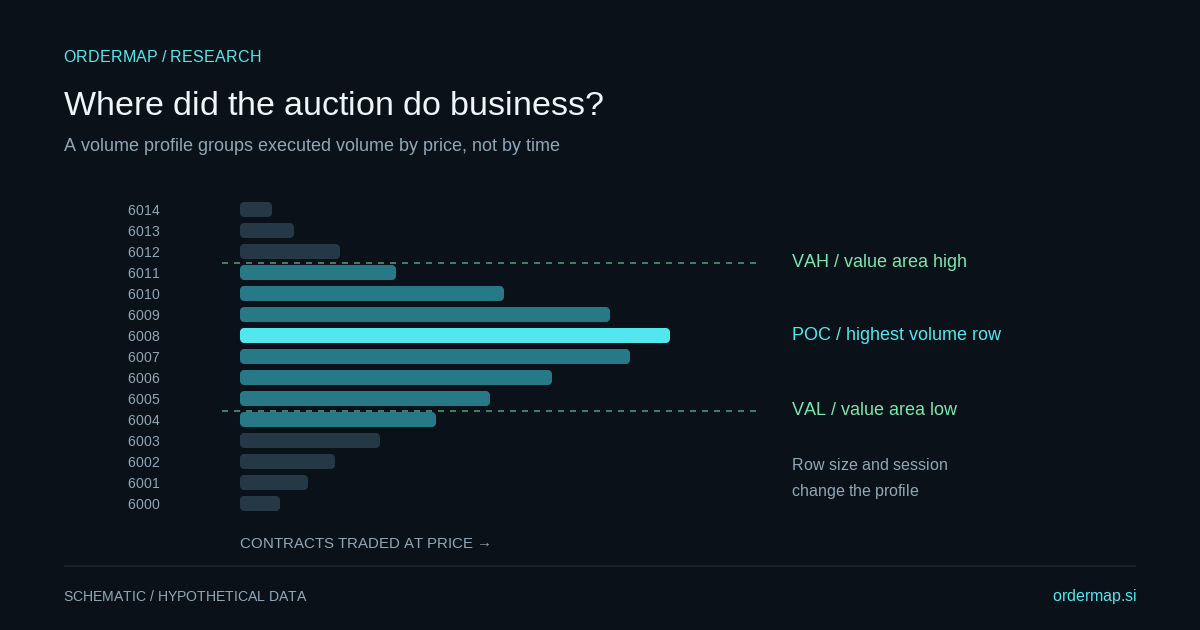
- RTH levels: the regular session's high, low, close, point of control and value area.
- Overnight levels: the overnight high and low, and the overnight profile.
The gap between yesterday's RTH close and today's 9:30 a.m. open is defined by RTH prices even though the contract traded in between. Whether today opens inside or outside yesterday's value area sets up different scenarios. We compare the two approaches in overnight versus regular-session profiles and session and composite profiles.
Neither view is more correct. A full-session profile, 6:00 p.m. to 5:00 p.m., reflects everything that traded. An RTH-only profile reflects the hours when most volume and most options hedging occur.
Options hours matter to ES too
ES is tied to SPX options through hedging. SPX options trade during regular hours and, on Cboe, in a Global Trading Hours session overnight; Cboe's hours page lists the times. This means options-derived levels do not have to go stale at 4:15 p.m. When overnight option trades are included, gamma levels can be updated through the night and mapped onto ES prices; see SPX GEX levels and the ES basis.
Contract months and the roll
ES lists quarterly contracts expiring in March, June, September and December, with month codes H, M, U and Z. A symbol such as ESZ6 is the December 2026 contract. Most volume moves to the next contract about a week before expiry, a process called the roll. During roll week, check which contract your chart and your levels refer to, because the two months trade at different prices.
A practical routine around the clock
- After 5:00 p.m., record the RTH high, low, close and value area.
- Before 9:30 a.m., record the overnight high and low and where price sits relative to yesterday's value.
- Note the day's scheduled releases and their times.
- Trade your plan during the hours with liquidity that suits your size.
- Decide in advance whether you hold through the 5:00 p.m. break.
ES sessions in OrderMap
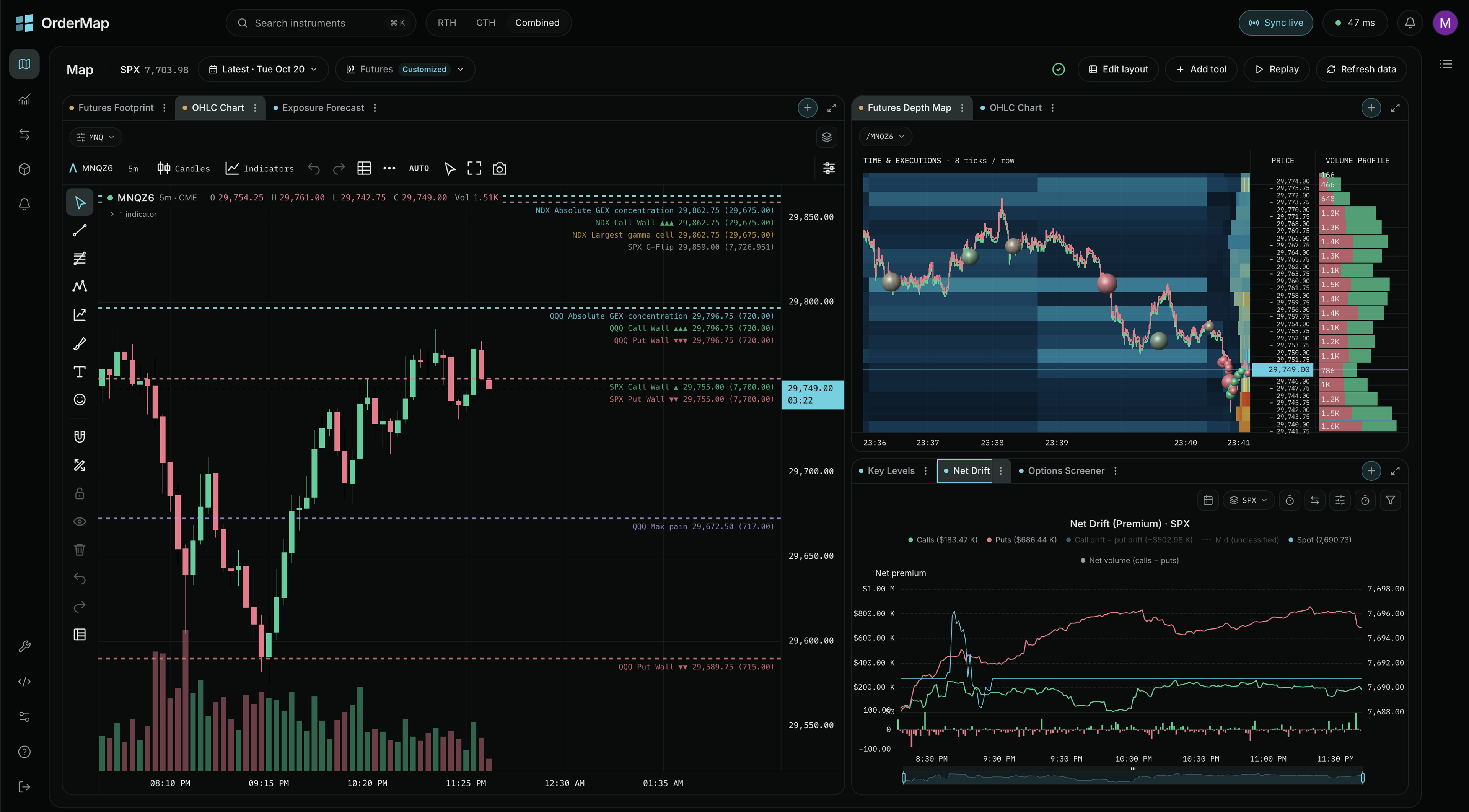
OrderMap's volume profile covers the full 18:00 to 17:00 ET futures session with the point of control and value area, and the depth map and footprint run through the overnight session as well as regular hours. Overnight GEX maps SPX exposure from Cboe Global Trading Hours flow onto ES and MES while the cash market is closed. Replay, on the Futures and Bundle plans, lets you study any part of a recorded session.
Questions
E-mini S&P 500 futures open on CME Globex at 6:00 p.m. Eastern Time on Sunday and trade until 5:00 p.m. Eastern Time on Friday, with a one-hour break each day from 5:00 to 6:00 p.m. Always confirm against CME's holiday calendar.
Traders use "RTH" for the hours when the US stock market is open, 9:30 a.m. to 4:00 p.m. Eastern Time. The futures themselves trade almost around the clock; RTH is a convention for charts and volume profiles.
Yes. NQ, MES and MNQ are CME equity index futures and follow the same Globex schedule as ES.