Order-Flow Risk: Position Sizing Before the Perfect Signal
Translate invalidation into position size, include fees and slippage, and evaluate expectancy without letting attractive order-flow patterns override risk.
By OrderMap Research4 min read
On this page
A detailed signal still needs a bounded loss plan
A footprint imbalance, gamma concentration, or volume-profile rejection can look compelling. None determines how much capital should be exposed. Position sizing begins with the consequences of being wrong, including the possibility that execution is worse than the chart suggests. The most attractive pattern in a journal can still be unsuitable at the wrong size.
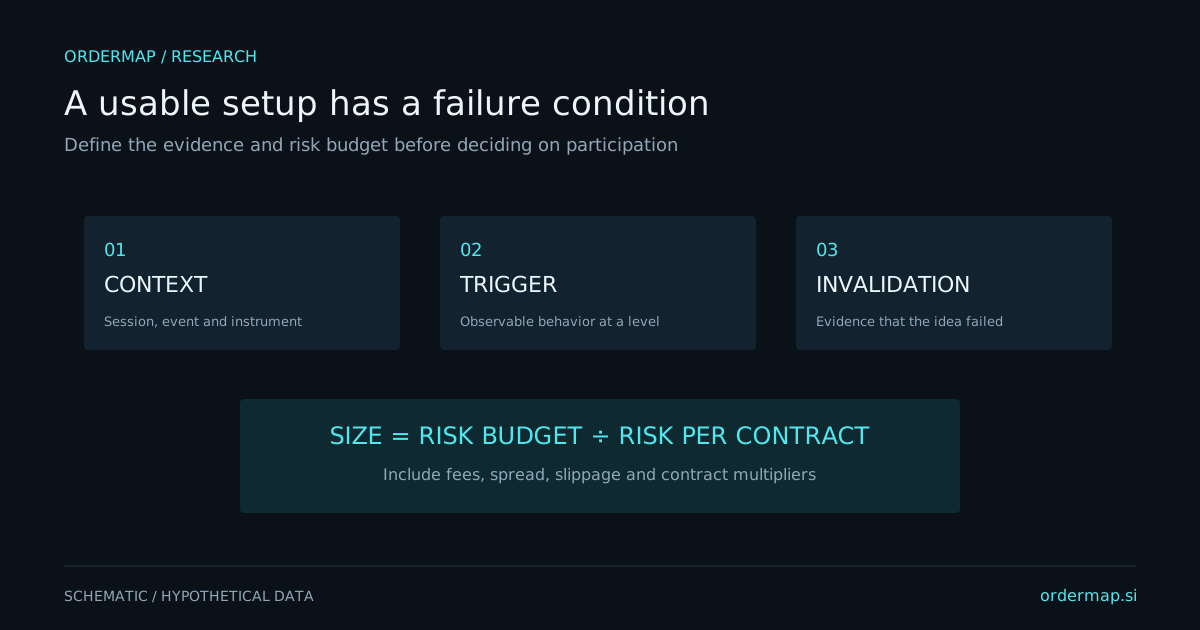
Start by writing the thesis and what would invalidate it. For example, a hypothetical rotation idea may depend on rejection of a value boundary. Sustained acceptance beyond that boundary contradicts the thesis. The invalidation should come from the market logic, rather than being squeezed into an arbitrary dollar amount by placing an unrealistically tight stop.
Work from per-unit loss to quantity
Assume a hypothetical futures instrument worth $5 per point. A proposed entry is eight points from invalidation, creating $40 of price risk per contract. Add an illustrative $10 allowance for fees and adverse execution. Estimated planned loss is $50 per contract. A hypothetical $150 research risk budget would permit at most three contracts under those assumptions.
| Input | Hypothetical value | Why it matters |
|---|---|---|
| Distance to invalidation | 8 points | Connects size to the thesis |
| Value per point | $5 | Converts movement to dollars |
| Price risk per contract | $40 | Distance times contract value |
| Cost and slippage allowance | $10 | Avoids assuming frictionless execution |
| Planned per-contract loss | $50 | Basis for the quantity calculation |
| Illustrative risk budget | $150 | Produces a maximum of 3 contracts |
The numbers are deliberately generic. Verify the actual contract multiplier, tick value, fees, and account constraints. Round quantity down. If the smallest available unit exceeds the budget, the arithmetic says the setup is too large under the plan; it does not justify moving invalidation closer without a new thesis.