Session vs Composite Volume Profiles: Choose the Right Window
Decide when to use session, fixed-range, and composite profiles, and avoid mixing contracts or changing anchors after the outcome is known.
By OrderMap Research4 min read
On this page
The window is part of the hypothesis
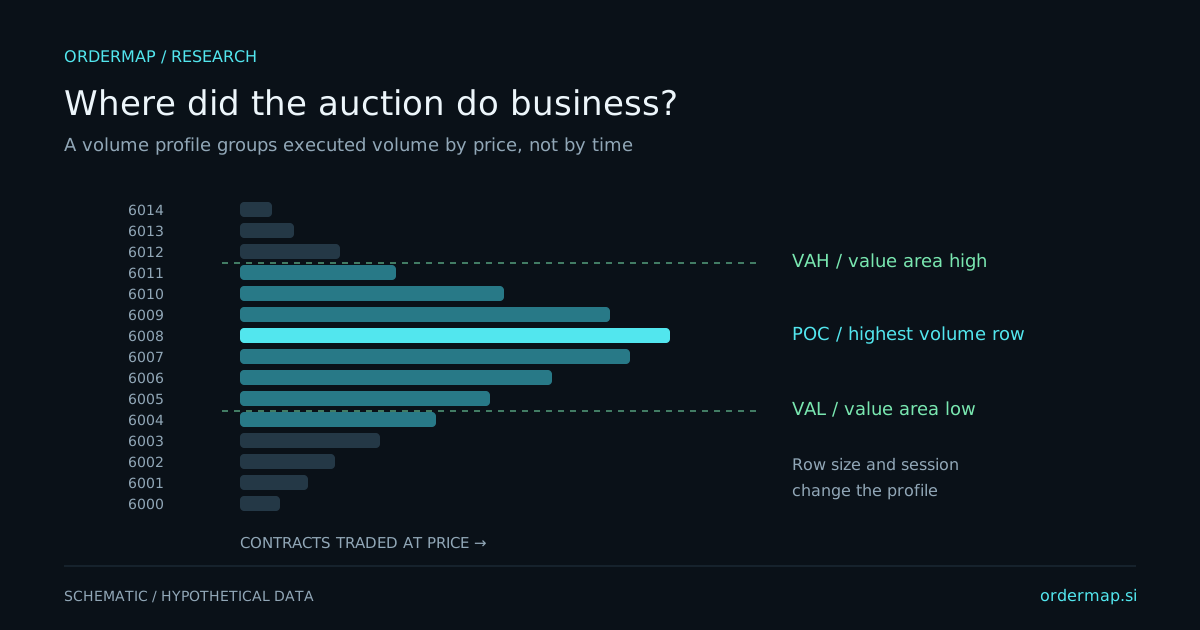
A session profile describes one trading session. A composite combines several sessions or a larger interval. A fixed-range profile uses explicitly selected start and end points. These are different samples of transactions, so different POCs and value boundaries should be expected. The chart is answering the question embedded in its window.
Use a session profile to describe the current auction. Use a composite to examine a broader area in which repeated business has accumulated. Use a fixed range to study a specific event or swing, provided the anchor rule is clear. More days do not automatically mean a more important level; stale activity can obscure a recent repricing.
Start with a three-layer map
A practical research layout can contain a prior-session profile, a developing current-session profile, and one broader composite. This gives enough context to ask whether today is rotating inside an established area or building value somewhere else. Adding ten overlapping profiles often creates more possible explanations than useful decisions.
| Profile | Question it answers | Main risk |
|---|---|---|
| Prior regular session | Where did that session concentrate activity? | Ignoring overnight repricing |
| Current developing session | Where is today's business accumulating? | Using incomplete volume as if final |
| Multi-session composite | Which broader areas have repeated activity? | Merging distinct regimes into one shape |
| Event-anchored range | How did trading develop after a catalyst? | Choosing the anchor after seeing the outcome |
Define which layer takes priority. For example, a broad composite can establish location while current-session volume determines whether acceptance is changing. That hierarchy prevents an old node from overruling every contrary observation simply because it contains more historical contracts.