GEX Around CPI and FOMC: Plan for a Broken Regime
Build conditional gamma scenarios around macro releases, volatility repricing, and changing liquidity without assuming a level can absorb every shock.
By OrderMap Research4 min read
On this page
An event can change several model inputs at once
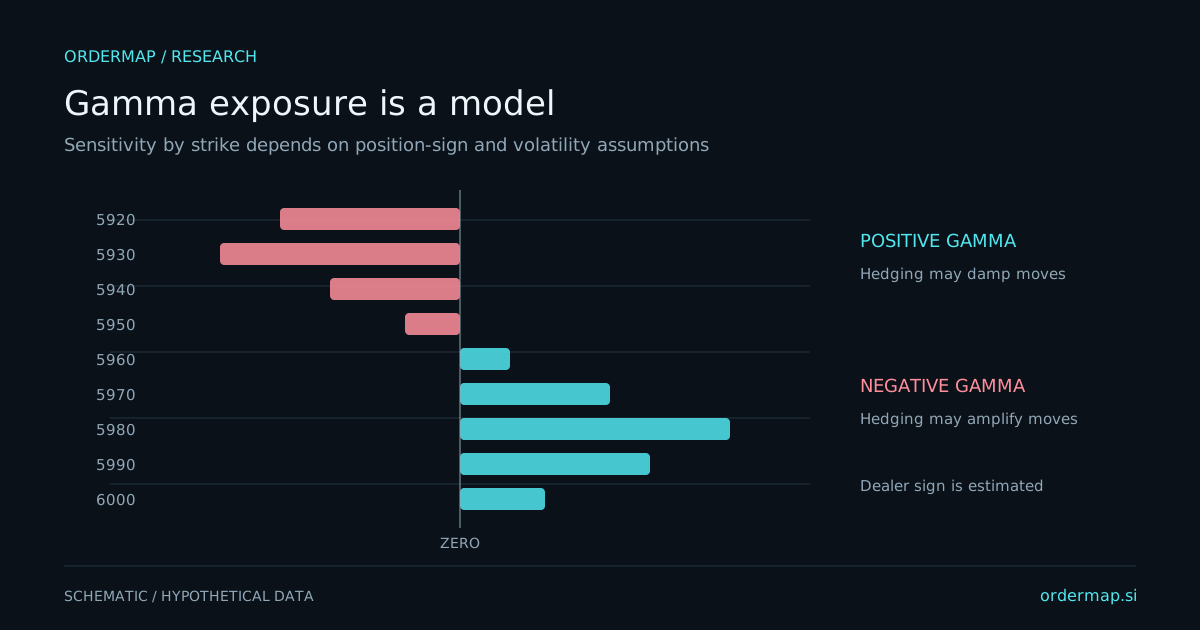
A macro announcement can move price, implied volatility, liquidity, and the distribution of options trading within seconds. A pre-event GEX chart describes the assumptions before those changes. It should not automatically remain the governing map after the release. This is particularly relevant when short-dated options dominate a modeled concentration.
The useful question is not whether a gamma wall is “strong enough” to stop CPI or an FOMC announcement. It is which assumptions remain usable after the market processes new information. Price can gap across a level without offering a meaningful test. A nearby line is not evidence that a market order can be filled at that line.
Write scenarios before the clock starts
Suppose an invented market is trading at 6,010, with a modeled upper concentration around 6,040 and a lower transition zone around 5,990. The session has been quiet. Instead of declaring that price will stay between those references, write three possible post-release states: renewed balance, upside acceptance, and downside acceptance.
| Post-event observation | Research interpretation | What would weaken it |
|---|---|---|
| Brief excursion, then return to prior value | Initial repricing failed to persist | New volume begins building outside value |
| Sustained trade above the prior range | Higher prices finding participation | Fast return through the old boundary |
| Sustained trade below the transition zone | Downside expansion candidate | Recovery of prior value with stable liquidity |
| Conflicting prices or stale exposure inputs | Analysis temporarily unreliable | Fresh synchronized data and a stable range |
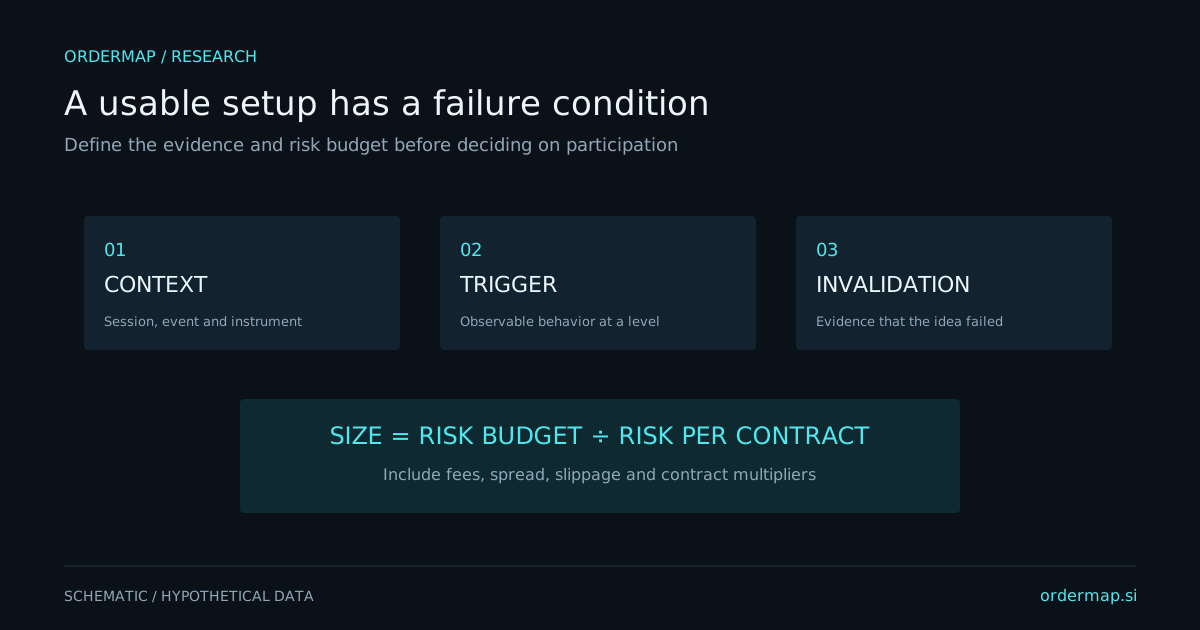
The table defines observations. It does not assign trade size or a required action. Staying flat while inputs become coherent can be the planned outcome. A research routine should include that choice explicitly, rather than treat every release as an obligation to participate.