Top 5 Market Replay Products in 2026: Match Data to Practice
Compare five documented replay tools, distinguish recorded depth from generated data, and design a practice routine that avoids hindsight.
By OrderMap Research··4 min read
On this page
A replay tool can improve practice only if the replayed data supports the lesson. A bar-by-bar study of price structure needs different inputs from a review of resting-order withdrawals. The presence of a play button tells you little about the fidelity of the underlying record.
This guide was checked against official sources on October 19, 2026. The five picks are ordered by different documented review workflows, not measured realism, simulated returns or platform speed. OrderMap publishes the guide and has a commercial interest in replay analytics. We have not independently tested every mode or provider configuration.
Sierra Chart's replay documentation is relevant when your research already lives in chart studies. Its depth-replay requirements make storage planning part of the evaluation.
Choose the lesson before choosing the archive. If the question concerns the historical book, verify actual depth for the interval. If it concerns a price-and-volume condition, identify the necessary execution detail. A missing source cannot be fixed by slowing playback. The value of the tool lies partly in making that limitation understandable.
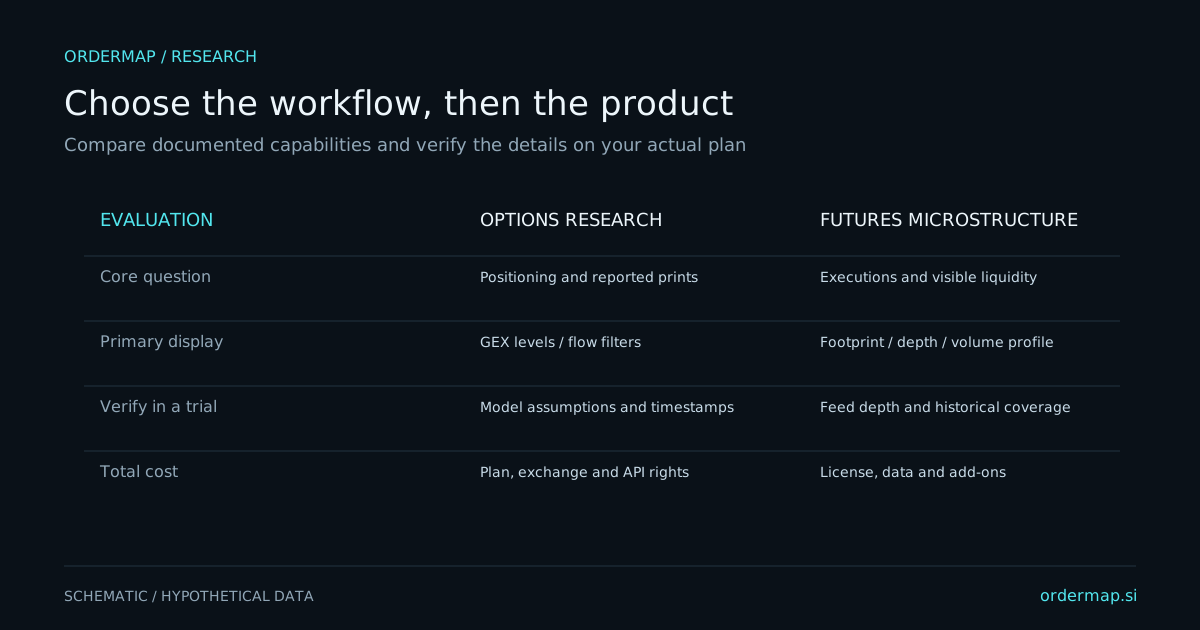
Learn what options prints, futures footprints, liquidity heatmaps and gamma models can answer, then build a focused workflow without duplicating tools.
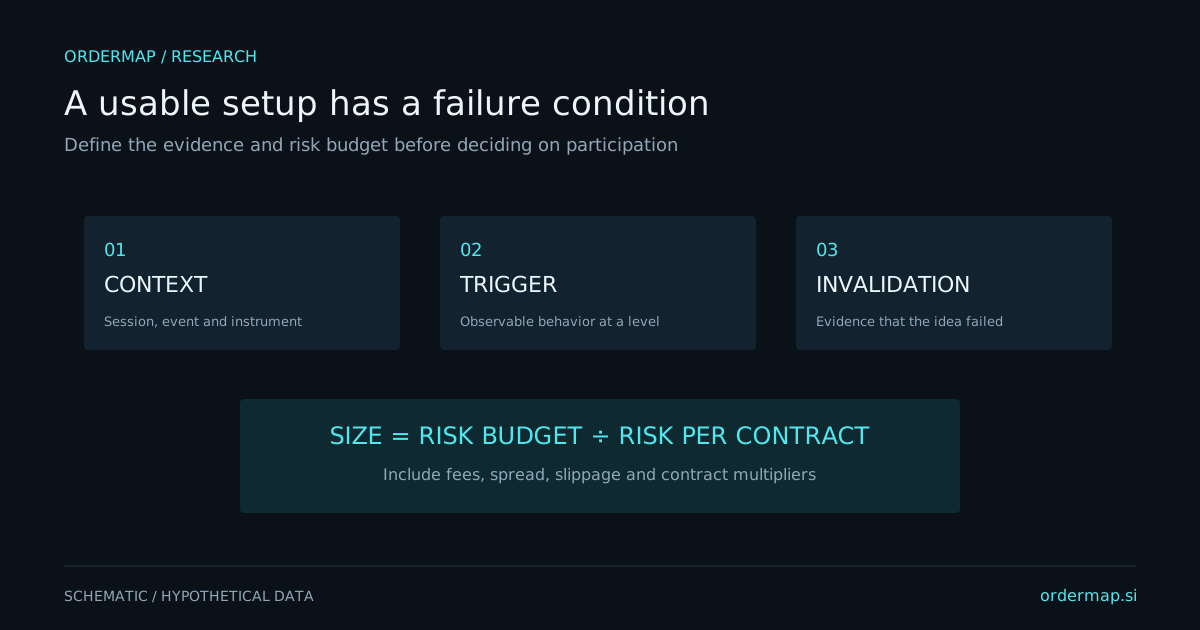
Translate invalidation into position size, include fees and slippage, and evaluate expectancy without letting attractive order-flow patterns override risk.
Bookmap documents feed files containing market data for replay, with separate order-file handling. It is a candidate when the review begins with a session you deliberately recorded.
Evaluate the recording routine as carefully as the replay controls. Can you identify the correct instrument, start time and missing intervals afterward? Practice that workflow before relying on it for an important session. A detailed display that was never recorded cannot serve as evidence merely because you remember seeing it live.
ATAS describes multiple modes, including generated ticks and DOM, ticks with generated DOM, and ticks with recorded DOM. That separation is useful for matching data fidelity to the exercise.
Generated components can be suitable for navigation practice or certain price-pattern drills. They cannot validate a historical claim about exactly which displayed orders withdrew. During evaluation, put the selected mode in your journal. A result is only interpretable when you know which observations were recorded and which were modeled.
NinjaTrader documents Playback using Market Replay data or historical ticks, with meaningful differences in depth availability and processing assumptions. It is a candidate when you want to inspect those modes within its workflow.
Keep platform replay, indicator tick processing and fill simulation conceptually separate. A detailed chronological input does not automatically make simulated fills equivalent to live execution. Ask whether the lesson is about observing a condition, responding to it or estimating a realistic executable result. Those require different levels of evidence.
Quantower's Market Replay documentation describes selectable data types and execution configurations. It is relevant to traders who want to build a deliberate manual practice session around a chosen instrument.
Test the assumptions before interpreting the outcome. Data type, commissions and execution modeling can change what a practice result means. A convenient replay is useful, but convenience should not be mistaken for a faithful reconstruction of every market detail. Match the exercise to the mode instead of retroactively expanding the claim.
A practice workflow, not a record of trading results. Replay quality depends on the source and the selected mode.
Select sessions by a rule before inspecting their finished charts. You might use every third session, a fixed calendar set or a predeclared event category. Selecting only visually impressive reversals builds a misleading practice sample.
Begin before the decision region. Write your hypothesis using only the information available at the playback clock. State the observation that would invalidate it. Advance at a speed that still permits the decision you are practicing, and record when you paused. Pausing can be useful for learning, but it changes the conditions relative to live observation.
Afterward, classify the error. Did you misunderstand the data, apply the rule inconsistently, miss the event or face an outcome your method legitimately permits? Each problem calls for a different correction. Replaying the same favorable example faster is not a substitute for diagnosing the actual weakness.
Queue priority, latency, slippage and market impact complicate fill assumptions. A chart touching a price does not guarantee a live limit order would fill. A replay profit is not evidence that the same decision would have been executable at the same size in the live market.
For software selection, confirm recording prerequisites, available history, exact exchanges, local storage and package access. Define your intended retention period. A replay feature and an unlimited historical archive are separate products, even when the interface makes them look adjacent.
OrderMap's replay uses a bounded private tape and an independent clock, with actual coverage and separate controls. It does not reconstruct a missing exchange book or place orders. Explore OrderMap's platform, plans and the futures order-flow shortlist if reviewing connected analytical observations is your goal.
Choose the replay tool that makes the lesson and its assumptions clearest. The practical benefit comes from more honest review, including the cases where your original interpretation was wrong.
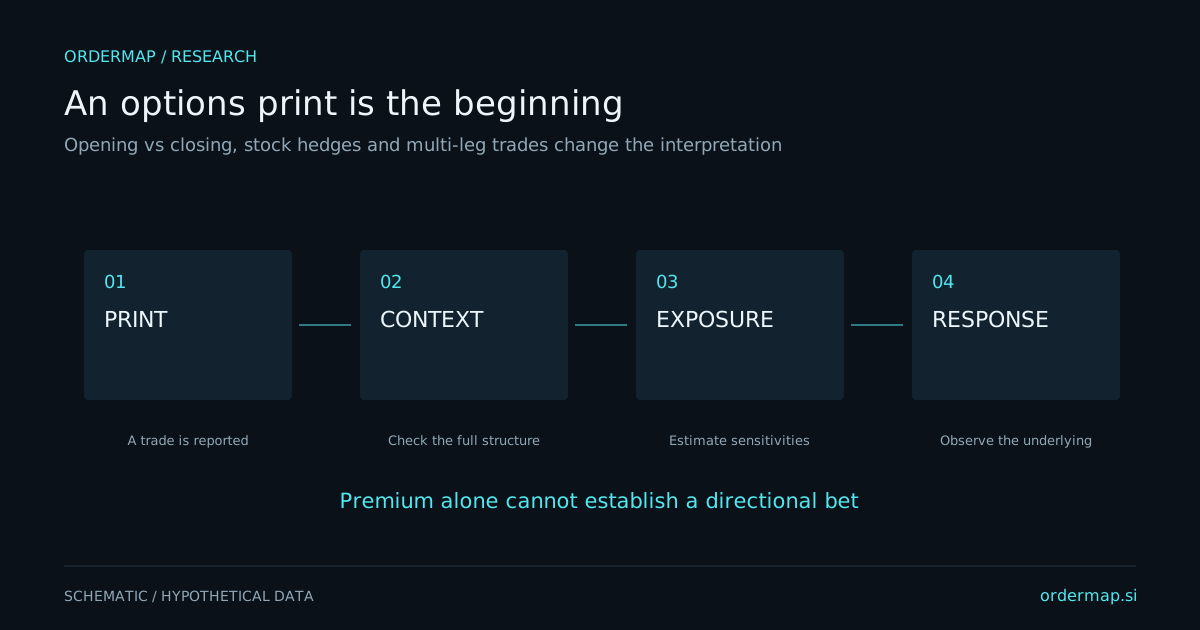
Compare five documented options flow services by filtering, contract context and research workflow, with a disciplined trial plan and clear limitations.