Top 5 Options Flow Products in 2026: A Research Shortlist
Compare five documented options flow services by filtering, contract context and research workflow, with a disciplined trial plan and clear limitations.
By OrderMap Research4 min read
On this page
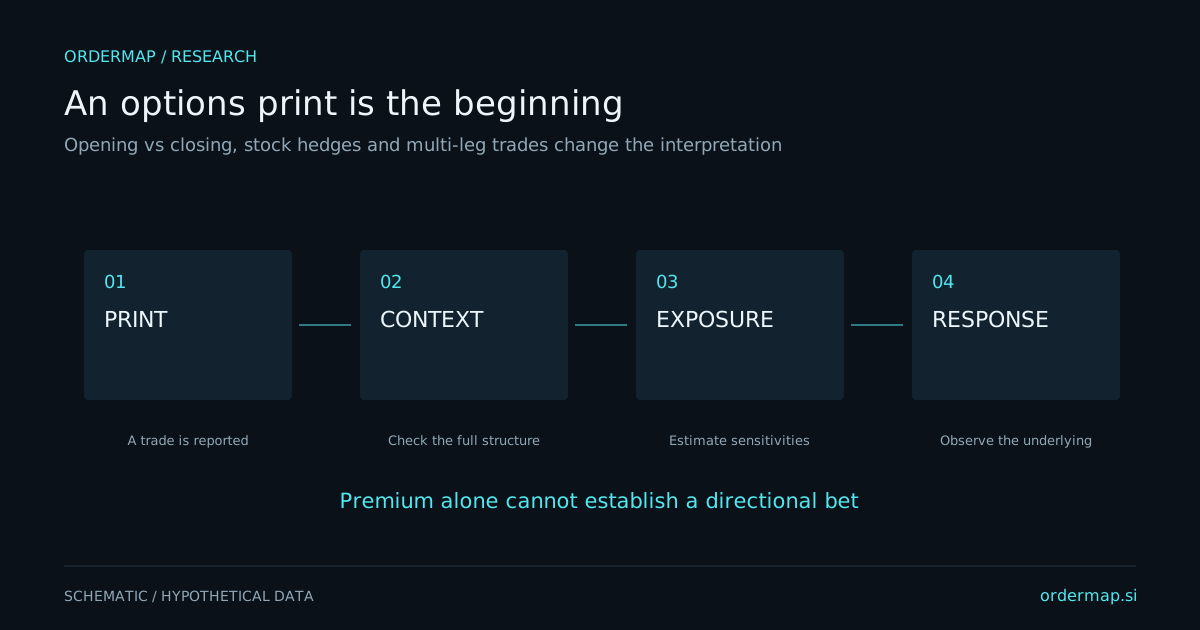
An options-flow product should help you investigate activity without pretending to reveal an entire participant's intention. The best shortlist is therefore organized around discovery, filtering and contract context. A spectacular premium number is a reason to ask questions, not proof that someone knows the next price move.
Official sources were checked on October 19, 2026. The numbered order is an editorial progression through different research workflows, not a measured ranking of data quality, speed or returns. OrderMap publishes this guide and has a commercial interest in related products. We have not independently tested every vendor's authenticated interface.
The five-product comparison
| Pick | Product | Documented offering | Useful evaluation focus |
|---|---|---|---|
| 1 | Unusual Whales | Options-flow feed | Can the feed support the contract questions in your routine? |
| 2 | Quant Data | Filtered options analysis and Net Drift | Can you distinguish selected premium from the whole market? |
| 3 | OptionStrat | Unusual flow with strategy-oriented context | How are related legs interpreted and displayed? |
| 4 | Cheddar Flow | Options-flow and order-detail tools | Can you inspect the context behind an alert? |
| 5 | FlowAlgo | Curated options activity including sweeps and blocks | Do its selected alerts fit your discovery process? |
1. Unusual Whales for a feed-centered research routine
Unusual Whales is a candidate when your process begins with examining an options-flow feed and narrowing the universe. Start by choosing one underlying and identifying the contract detail you need to retain.
During evaluation, inspect ordinary trades as well as dramatic ones. A platform should remain understandable when the feed is noisy or the interpretation is neutral. Save a few observations where the apparent directional story was ambiguous; those examples teach more about a tool's limits than a collection of successful-looking alerts.