Options Max Pain Explained: Calculation, Uses and Limits
What options max pain is, how the max pain strike is calculated from open interest, why SPY and single-stock max pain get searched, and where it fails.
By OrderMap Research4 min read
On this page
Max pain in one sentence
Max pain is the strike at which, if the underlying settled there on expiration day, the combined payout to everyone holding options in that expiration would be smallest. It is calculated entirely from open interest. It is not a forecast, and nothing in the calculation knows which way the market wants to go.
Interest in the term rises around monthly and quarterly expirations and whenever a heavily traded single stock approaches a large expiry, which is why searches such as "SPY max pain today" spike each week. This guide shows the calculation, explains why the idea persists, and is direct about its limits.
How the max pain strike is calculated
For one expiration:
- List every strike with its call open interest and put open interest.
- Pick a candidate settlement price, normally each strike in turn.
- For that price, add up the intrinsic value of every call (settlement minus strike, if positive, times open interest) and every put (strike minus settlement, if positive, times open interest).
- Repeat for every candidate price.
- The candidate with the lowest total is the max pain strike.
A small example with three strikes and a 100 multiplier left out for clarity:
| Strike | Call OI | Put OI | Total payout if settled here |
|---|---|---|---|
| 95 | 1,000 | 4,000 | Calls 0 + puts (100-95) x 3,000 + (105-95) x 1,000 = 25,000 |
| 100 | 5,000 | 3,000 | Calls (100-95) x 1,000 + puts (105-100) x 1,000 = 10,000 |
| 105 | 4,000 | 1,000 | Calls (105-95) x 1,000 + (105-100) x 5,000 = 35,000 |
The 100 strike produces the smallest payout, so 100 is max pain for this expiration. Real chains have dozens of strikes, but the arithmetic is the same. The Options Industry Council covers intrinsic value and open interest if those terms are new.
Why people watch it
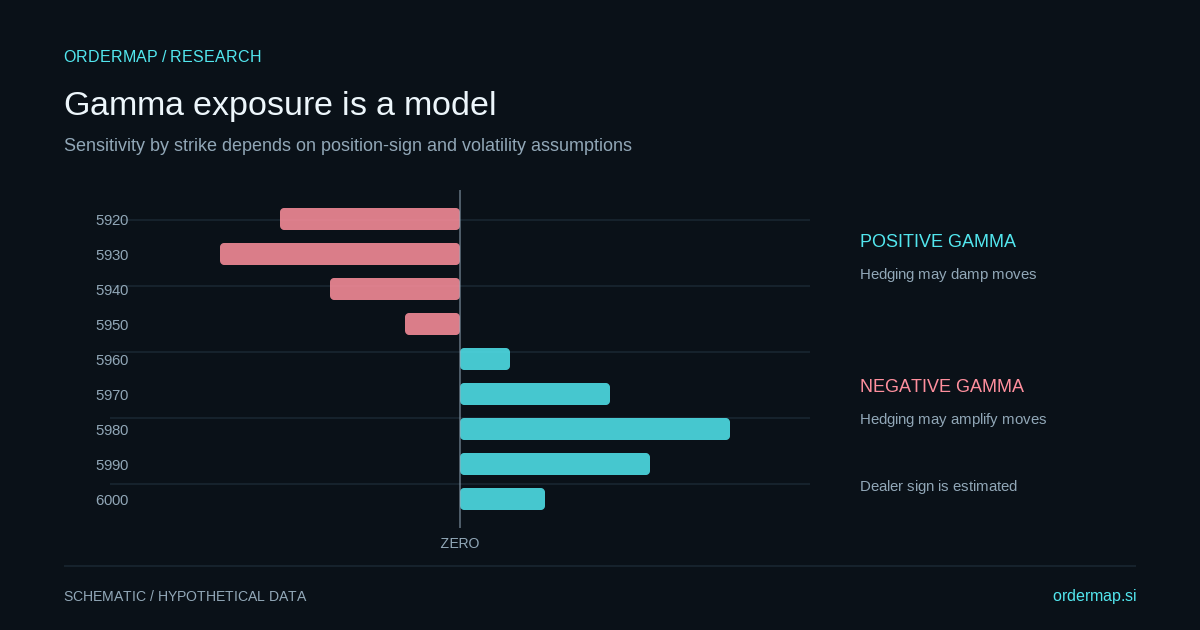
The theory behind max pain says option writers, often assumed to be dealers, benefit when options expire worthless and that hedging keeps price near the strike where that is most true. There is a real mechanism nearby. When dealers are long gamma around a large strike, their hedging sells as price rises above it and buys as price falls below, which can hold price close into the close. Researchers call the result pinning.
The mechanism depends on gamma and on who holds the options, though, not on total payout. Max pain uses neither. It weights a deep in-the-money contract the same as an at-the-money one, although the first has almost no gamma left. That is why max pain and the strike with peak net GEX can sit in different places, and why the gamma-based level is usually the better guide to hedging pressure.
Where max pain fails
- Trending markets. A stock moving on earnings or an index moving on a policy decision will settle wherever the news takes it.
- Far-dated expirations. Three weeks out, the hedging that could cause pinning is weak and open interest will change many times.
- Stale data. Open interest is published once a day, after clearing. Contracts opened and closed during the session do not appear until the next morning; see volume versus open interest.
- Multi-leg positions. A spread shows up as open interest at two strikes, but its holder's payout depends on both legs. Max pain treats them as unrelated.
- Daily expirations. With an expiration every trading day on SPX and SPY, the open interest in any single one is a smaller share of total positioning.
How to use it sensibly
Treat max pain as one line on an expiration-day map, and only under conditions that favor pinning:
- It is expiration day or the day before for the series you calculated.
- No scheduled catalyst falls before the close.
- Price is already within the expected move of the max pain strike.
- A gamma-based level, such as the largest net GEX strike, sits at or near the same price.
When all four hold, a drift toward the strike into the afternoon is a reasonable scenario to plan for. When any is missing, the number is trivia. In every case, the trade decision should rest on what price and volume do at the level. Our 0DTE gamma article describes how same-day contracts can strengthen or cancel the effect.
Why single stocks get searched
Queries for max pain on names like SPY, NVDA, TSLA and GME cluster around weekly expirations. Single stocks do pin on some Fridays, usually when one strike holds far more open interest than its neighbors and nothing else is happening. They also break away violently when a crowded strike is cleared. Before relying on a single-stock max pain value, compare the open interest at that strike with the stock's average daily share volume. If the options represent a small fraction of a normal day's trading, hedging them cannot hold the price anywhere.
Max pain in OrderMap
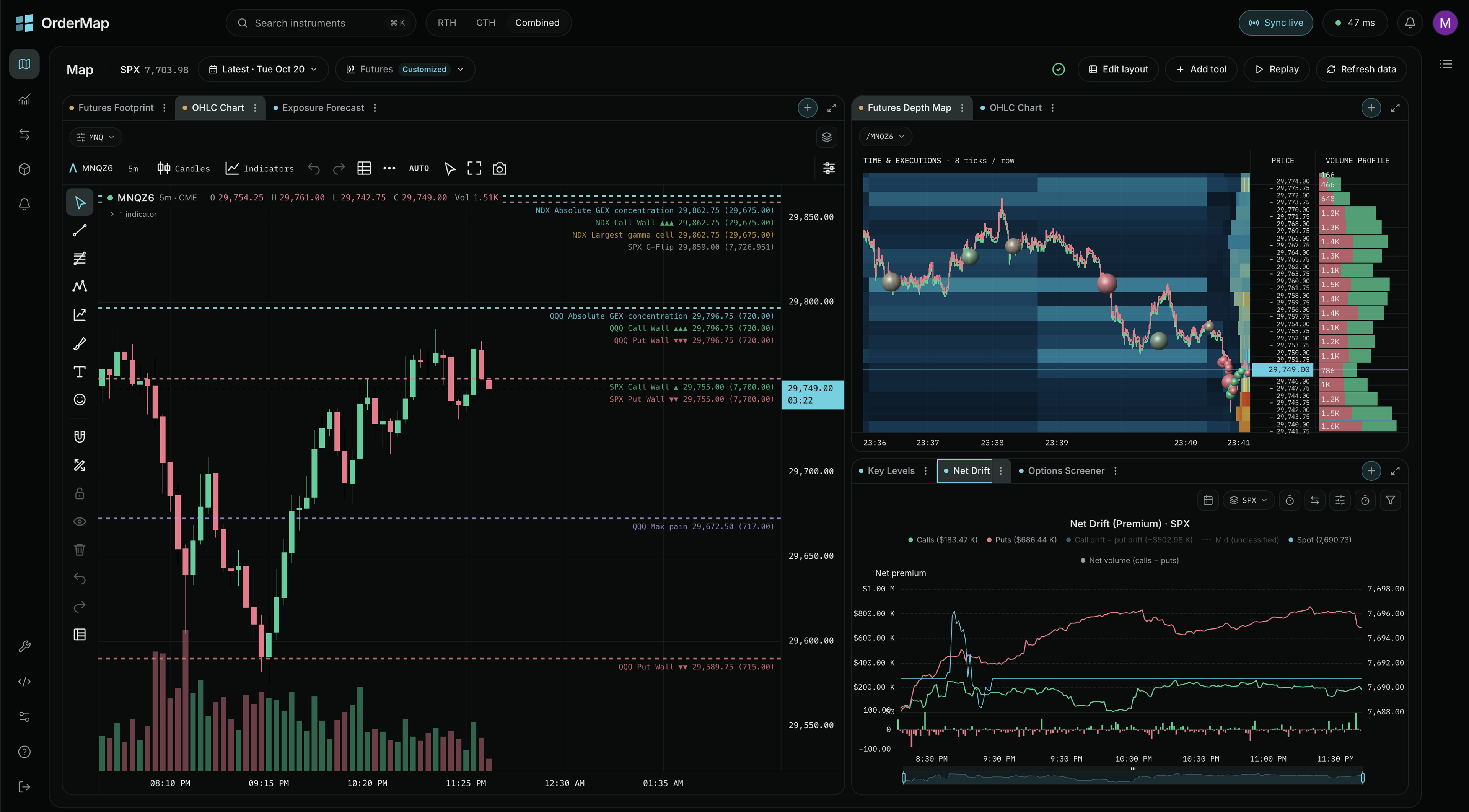
Key Levels shows max pain beside the call wall, put wall, gamma flip, peak net GEX and expected move, so you can see at once whether the open-interest view and the gamma view agree. Exposure breaks the same chain down by strike and expiry. OrderMap is read-only analytics; nothing here is a recommendation to trade.
Questions
Max pain is the strike price at which the total intrinsic value of all open calls and puts for an expiration is lowest. At that settlement price, option holders as a group would receive the smallest payout.
No. Max pain is a description of open interest, not a force. Price settles near it on some expirations and far from it on others, especially when news or a strong trend dominates. Studies of pinning find an effect near large strikes, not a rule.
It can change every day, because it is recomputed from open interest, which exchanges publish once daily after clearing. A max pain value without a date is not usable.