GEX Levels Explained: Call Wall, Put Wall, Zero Gamma
What GEX levels are and how traders use them: call wall, put wall, zero gamma (gamma flip), net GEX and how SPX levels map onto ES futures prices.
By OrderMap Research4 min read
On this page
What traders mean by "GEX levels"
Searches for "GEX levels" have grown faster this year than searches for gamma exposure itself. The reason is practical: most traders do not want a chart of exposure by strike, they want a short list of prices to mark before the session. GEX levels are that list. They are derived from a gamma exposure model and reduce thousands of option contracts to four or five reference prices.
This article explains each level, how it is calculated in outline, how to move SPX levels onto ES futures, and what the levels cannot tell you. For the model underneath, start with gamma exposure explained.
The standard levels
| Level | Definition | Typical use |
|---|---|---|
| Call wall | Strike with the largest modeled call gamma | Upper reference; resistance in positive gamma |
| Put wall | Strike with the largest modeled put gamma | Lower reference; support in positive gamma |
| Zero gamma (gamma flip) | Price where modeled net gamma changes sign | Regime boundary between dampened and amplified moves |
| Peak net GEX | Strike with the highest absolute net gamma | Where pinning pressure is modeled to be strongest |
| Max pain | Strike that minimizes total option holder payout at expiry | Expiration-day reference only |
| Expected move | Range implied by at-the-money option prices | Sanity check for targets and stops |
Call wall and put wall
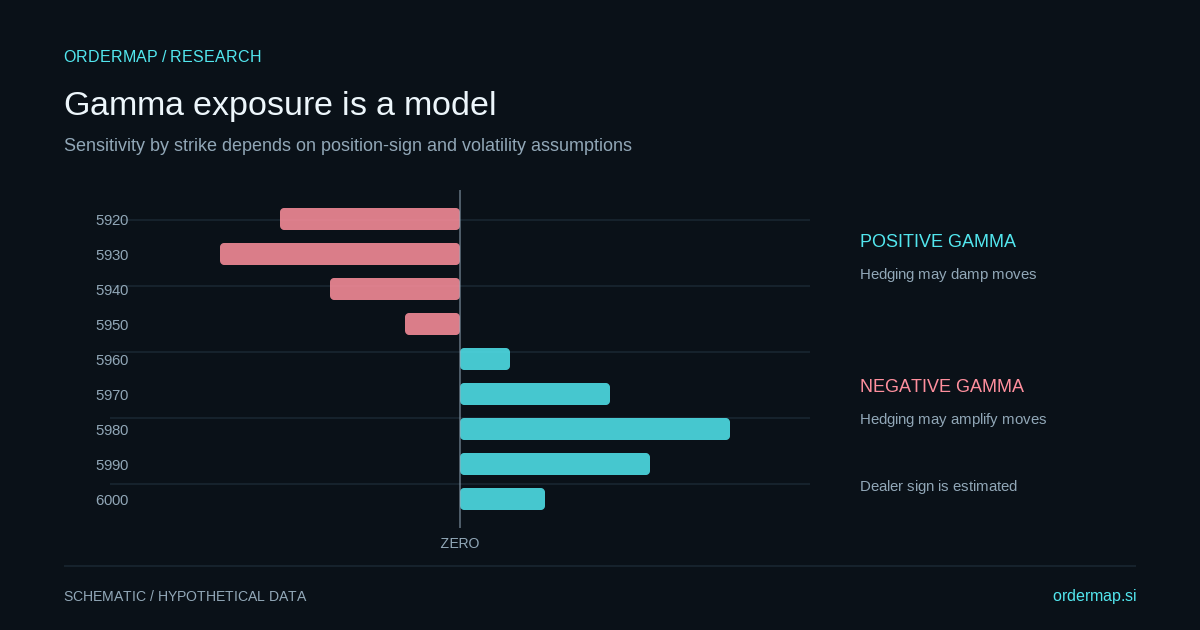
Sum the gamma exposure of every call at each strike and the largest total is the call wall; do the same for puts to find the put wall. Under the common assumption that dealers are long the calls customers sell and short the puts customers buy, hedging near the call wall involves selling into strength, and hedging near the put wall depends on the regime. The assumption is the weak point: public data shows open interest, not who holds it.
Zero gamma
Recalculate net gamma across a range of hypothetical spot prices and find where the total crosses zero. That price is zero gamma. It is not a strike and does not behave like support or resistance. Its value is as a boundary: when the market trades above it, the model says hedging flows oppose moves; below it, they add to them. Our gamma flip framework covers how to use the boundary without treating it as a signal.
Peak net GEX
The strike where calls and puts together produce the largest net gamma. On quiet days in positive gamma, price often spends time near it. On days with a catalyst it can be irrelevant.
From SPX to ES
Most index gamma sits in SPX options, but many traders execute in ES or MES futures. The two prices differ by the basis: futures trade above or below the cash index depending on interest rates, expected dividends and days to the futures expiry.
To convert, take the SPX level and add the current basis. If SPX is 6,000.00 and ES is 6,032.50, the basis is 32.50, so an SPX call wall at 6,050 corresponds to about 6,082.50 on ES. Two cautions apply. The basis changes during the day, so a morning conversion drifts by the afternoon. And at the quarterly roll the front contract changes and the basis jumps. The full method is in SPX GEX levels and the ES basis.
Why levels move during the day
Levels calculated once from the previous day's open interest are static. In reality positioning changes as contracts trade, and same-day expirations now make up a large share of SPX volume; Cboe has published research on 0DTE options and their market impact. A wall at the open can be a minor strike by lunchtime if the contracts that built it are closed.
So ask of any GEX level: when was it computed, from which expirations, and does it update with intraday flow? A level without a timestamp is a guess about yesterday. See 0DTE gamma intraday for how same-day contracts change the picture.
What GEX levels do not tell you
- Direction. A call wall above and a put wall below describe a range the model considers likely to hold, not which side breaks.
- Certainty. Every level rests on an inventory assumption. Two honest vendors can publish different walls from the same open interest.
- Timing. Hedging pressure is strongest near expiry and near the strike. A wall forty points away with three weeks to expiry exerts very little.
Treat a level as a place to watch, then let trading evidence decide. If price reaches a call wall and aggressive buying is absorbed on the tape, the level and the order flow agree. If price trades through it on rising volume and holds, the level has failed and the regime may be changing.
A simple morning routine
- Write down the call wall, put wall, zero gamma and expected move with the time they were computed.
- Convert them to the contract you trade using the current basis.
- Note whether price is above or below zero gamma.
- Mark the nearest prior-session profile levels and see which GEX levels coincide with them.
- During the session, re-check the levels at set times, not after every tick.
GEX levels in OrderMap
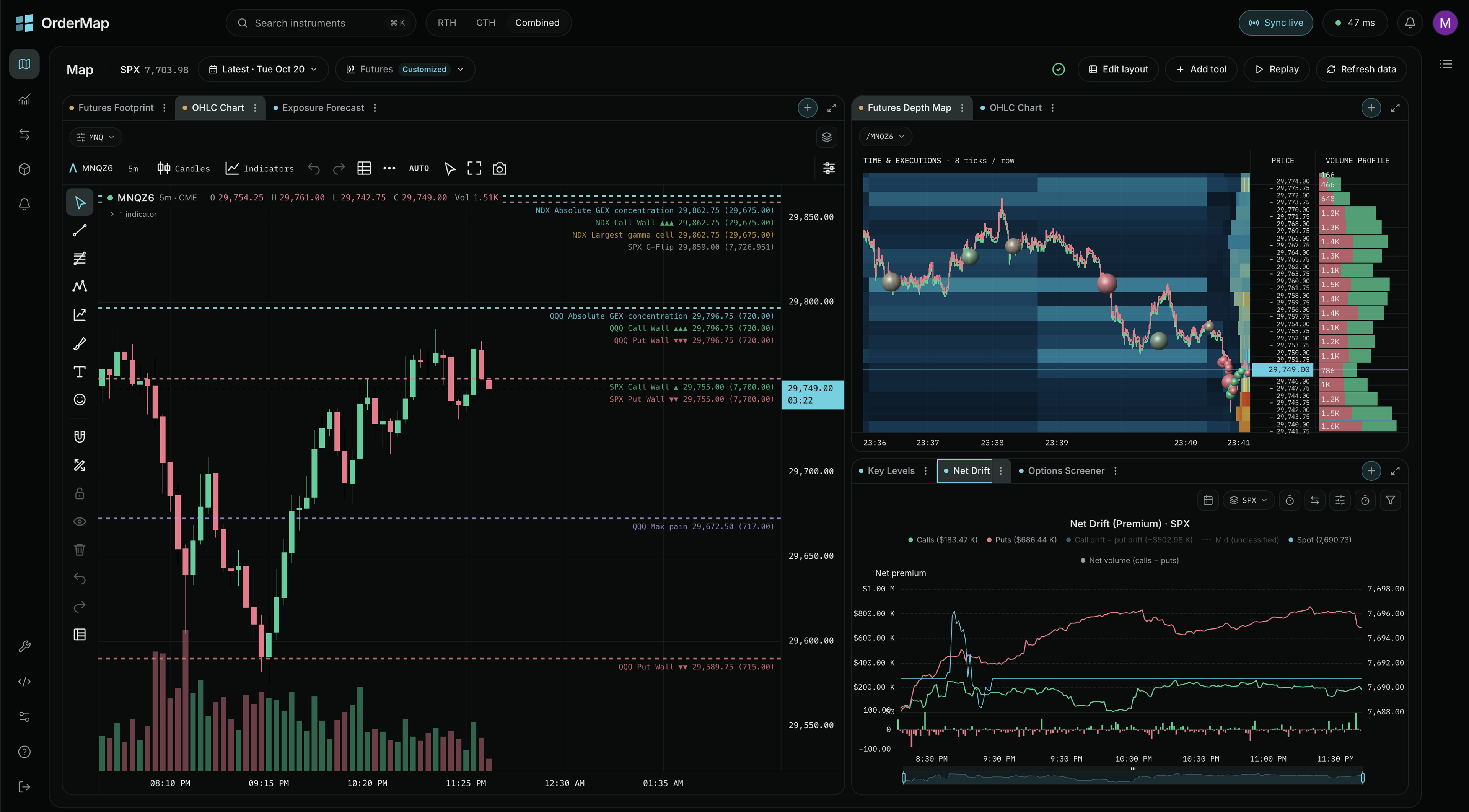
Key Levels lists the call and put walls, gamma flip, peak net GEX, max pain and expected move for a symbol, and Exposure shows the strike-by-strike picture behind them. Overnight GEX keeps SPX levels updating from Cboe Global Trading Hours flow and maps them onto ES and MES while the cash market is closed. The Futures plan includes GEX levels on ES and NQ charts.
Questions
GEX levels are prices derived from modeled options gamma exposure: the strikes with the largest call or put gamma (call wall and put wall), the price where net gamma changes sign (zero gamma or gamma flip), and the strike with peak net GEX.
Zero gamma, also called the gamma flip, is the underlying price at which a model's net dealer gamma crosses from positive to negative. Above it, hedging tends to dampen moves; below it, hedging tends to amplify them. It is a model estimate, not a traded price.
SPX and ES differ by the basis, which reflects interest rates and dividends until the futures expiry. Add the current basis to an SPX level to get the equivalent ES price, and update it during the day because the basis drifts.