HVNs and LVNs: Reading Acceptance and Thin Trading Zones
Use high and low volume nodes to frame market structure, distinguish traded activity from resting liquidity, and evaluate retests with evidence.
By OrderMap Research4 min read
On this page
A node is a feature of a chosen distribution
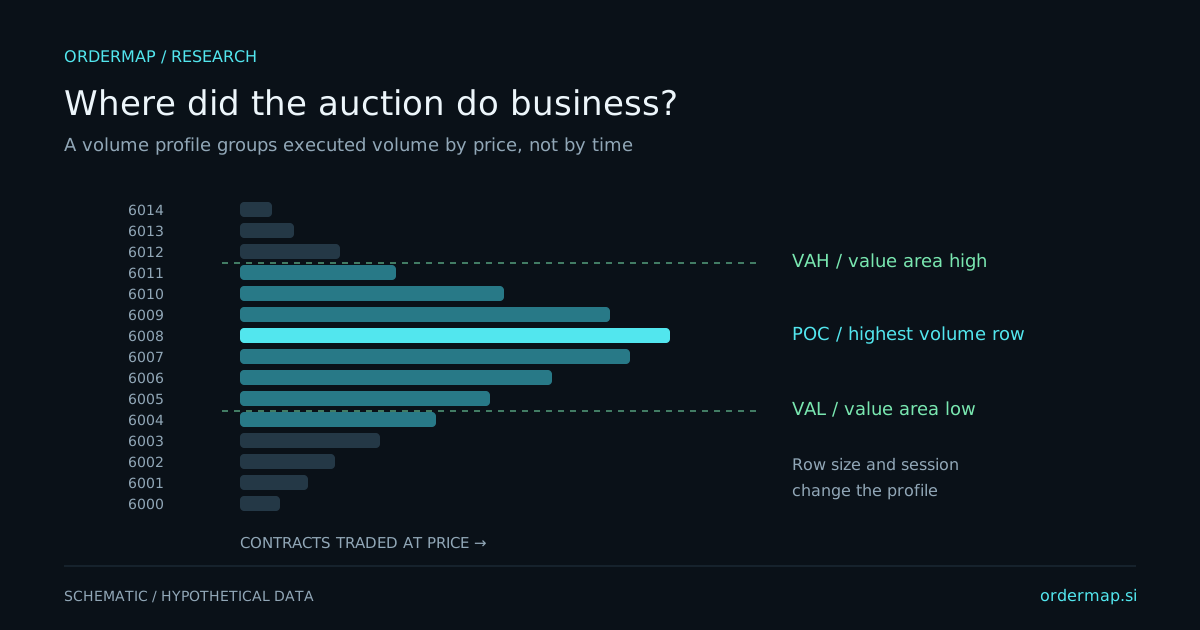
A high volume node, or HVN, is a local concentration of traded volume. A low volume node, or LVN, is a relative valley between more active areas. They describe the profile's shape. A local HVN need not be the session's point of control, and an LVN need not be a price where nothing traded.
These labels depend on scale. A valley visible with one-tick rows can disappear when rows aggregate several ticks. A quiet patch in one session can become a major node in a monthly composite. Before assigning meaning, state the instrument, dates, session hours, and row size. Sierra Chart's profile documentation illustrates the settings behind these distributions.
Why a thin zone can produce different outcomes
One common hypothesis is that price may travel quickly through an LVN because less business previously occurred there. Another is that the boundary of an LVN can attract a response from traders watching the separation between two accepted regions. Both are hypotheses. Neither turns an old low-volume row into a law governing the next visit.
If new information makes the thin region attractive, substantial new volume can build there and erase the old valley. If liquidity disappears, price can cross it with little trading. The same historic shape can accompany acceptance, rejection, or rapid transit depending on what participants do now.
| Current behavior near an LVN | Working interpretation | Observation to collect |
|---|---|---|
| Fast pass with little new volume | Transit through a sparse region | Whether activity grows at the next node |
| Repeated tests and immediate returns | Boundary attracting opposition | Follow-through after each rejection |
| Time and volume building inside | Old separation losing relevance | Developing profile and value migration |