Volume Profile Basics: POC, Value Area, and Better Questions
Read volume at price, distinguish the point of control from value boundaries, and build testable scenarios without assuming historical volume predicts support.
By OrderMap Research4 min read
On this page
A profile changes the axis of attention
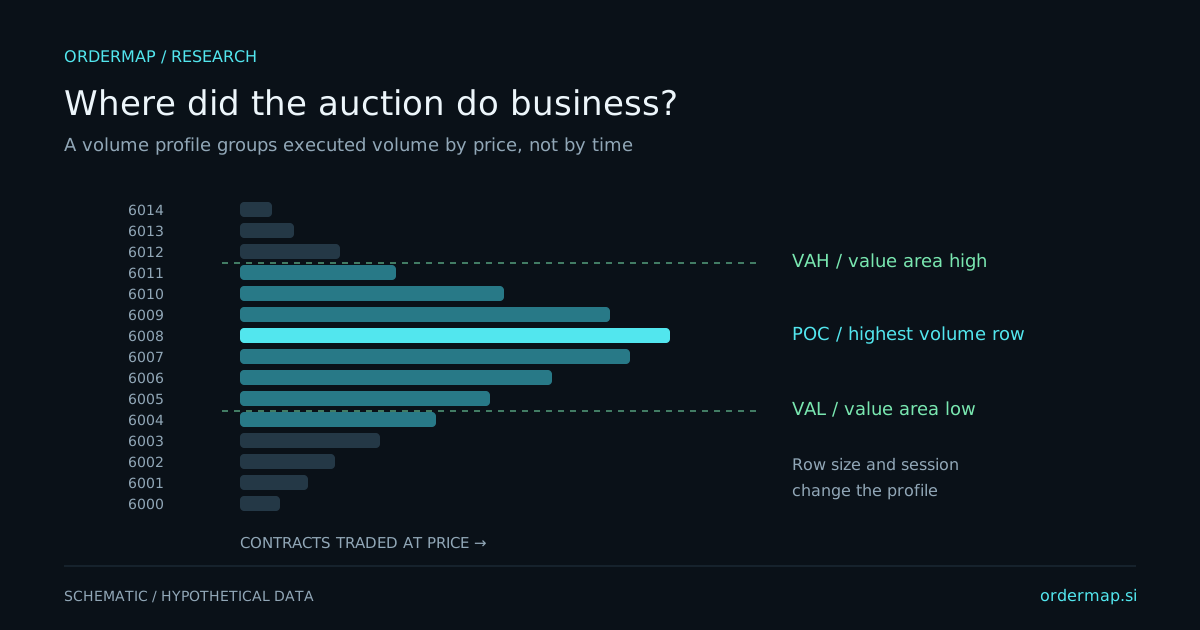
A conventional volume chart asks how much traded during each time interval. A volume profile asks how much traded at each price during a chosen interval. The same transaction contributes to both views, but the organization makes different relationships easier to see. Profiles are particularly useful for describing where activity clustered and where it was relatively sparse.
The point of control, or POC, is the price row with the highest included volume. A value area contains a chosen share of the distribution, often 70%, under a specified calculation method. Its upper and lower boundaries are called VAH and VAL. These labels describe the selected sample. They are not guarantees that price will return or that a boundary will hold.
Know how the picture was built
Every profile needs an instrument, a time window, a row size, and a volume source. Change any of those and the result can change. A one-tick futures profile preserves different detail from a profile combining ten ticks into each row. A regular-session profile answers a different question from a full-session one.
Value-area algorithms can also differ in how they expand around the POC, handle ties, or group adjacent rows. Sierra Chart's volume-by-price documentation makes these settings explicit. When comparing two charts, reconcile the inputs before deciding which level is “correct.”
| Element | What it describes | What it cannot establish alone |
|---|---|---|
| POC | Largest volume row in the selected sample | Future fair value or participant cost basis |
| VAH and VAL | Boundaries of a chosen volume share | A statistical confidence interval for tomorrow |
| Profile width | Relative activity at a price row | The amount of resting liquidity currently available |
| Developing POC |