Top 5 Trading Analytics APIs in 2026: Build or Consume?
Compare five analytics and market-data API candidates, distinguish calculated tools from raw inputs, and evaluate timestamps, permissions and total effort.
By OrderMap Research5 min read
On this page
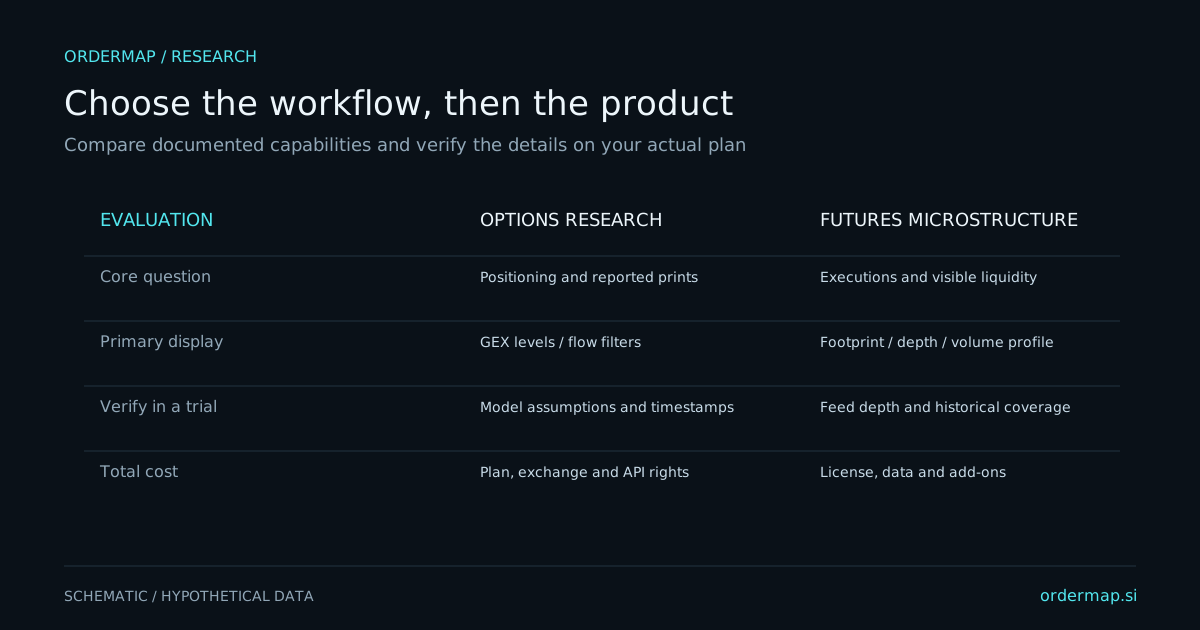
The first API decision is whether to consume a maintained calculation or build one from market inputs. Both approaches can be sensible. They have different responsibilities for classification, corrections, timestamps, storage and licensing, so comparing endpoint counts alone will not reveal the better fit.
Official documentation was checked on October 19, 2026. This is an editorial shortlist of five candidates spanning calculated analytics and research inputs. The ordering follows that spectrum; it is not a benchmark of uptime, speed, accuracy or cost. OrderMap publishes the guide and offers a related developer API, so readers should account for that commercial interest.
Five API candidates for analytical applications
| Pick | Provider | Documented offering | Best first question |
|---|---|---|---|
| 1 | Quant Data | Options tool endpoints including exposure, drift and flow | Does an existing calculation match my required metric? |
| 2 | Unusual Whales | Options-flow, Greek-exposure and other research endpoints | Does the endpoint supply the context my application needs? |
| 3 | Cboe DataShop | Equity and options quote/trade APIs with live, delayed and historical access | Which timing and usage permissions does my subscription provide? |
| 4 | Nasdaq Data Link | Dataset-specific APIs, SDKs and options-market research products | Does this dataset cover the market and activity my research needs? |
| 5 | Databento | Normalized market-data conventions and order-book snapshots | Do I need raw events to implement my own analytics? |
1. Quant Data for consuming options calculations
Quant Data's catalog documents a range of calculated options tools. It belongs on a shortlist when the desired result resembles an existing analytical endpoint rather than a custom reconstruction from every quote and trade.
During evaluation, select one endpoint and write its expected semantics in your own application specification. Define the unit, aggregation, filter scope and treatment of unavailable observations. If those do not match your intended metric, adding a thin wrapper will not necessarily resolve the conceptual difference. Inspect the calculation before investing in the integration.
2. Unusual Whales for research-oriented endpoint breadth
Unusual Whales documents programmatic access to options flow, Greek exposure and additional research datasets. It is a candidate when your application connects several forms of options-market context.
Begin with the data contract for one screen. A dashboard may need a latest observation, a historical series and enough metadata to explain a missing point. Confirm all three rather than assuming a broad catalog covers your exact composition. Breadth is useful only when the fields fit the decision your interface presents.
3. Cboe DataShop for quote and trade inputs
Cboe DataShop documents equity and options quote and trade endpoints across live, delayed and historical access. It is a candidate for applications that need market observations and will implement some of their own transformations. Confirm the selected subscription's timing, dataset and usage terms before relying on an endpoint for a customer-facing screen.
Treat optional fields as truly optional. An absent Greek should not become zero exposure, and a field unavailable under the selected plan should not be interpreted as an empty market. Build a small sample parser that preserves absence and records the underlying timestamps before designing a chart around a fully populated example response.
4. Nasdaq Data Link for dataset-focused research
Nasdaq Data Link documents APIs and SDKs for accessing its datasets. Its Nasdaq Options Trade Outline product describes options-market activity through a Tables API. Its stated coverage is the Nasdaq Options Market, so treat it as a specific research dataset rather than assuming it represents every U.S. options exchange.
Evaluate the operating model as well as the payload. Consider how the interface runs, how requests are bounded and how your application recovers after an interruption. A data source that fits a notebook may require additional work for a continuously available service. Include that work in the comparison rather than treating all HTTP-shaped access as operationally identical.
5. Databento for building from market events
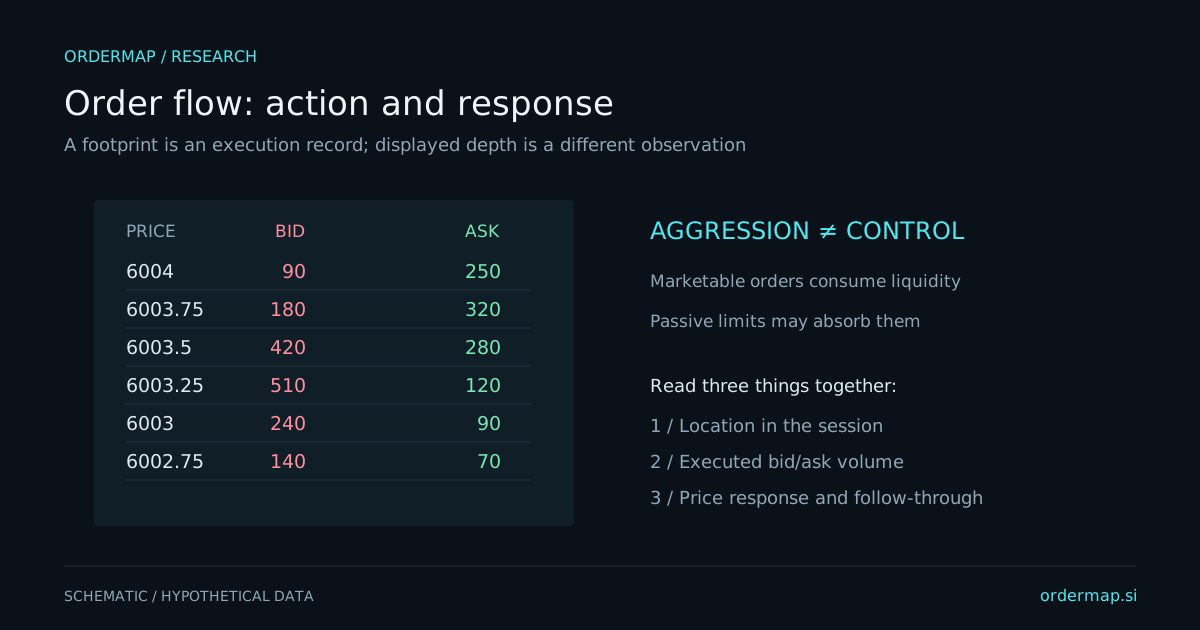
Databento's MBO schema documents order-book events and identifiers. It is a candidate when you need to construct your own book or execution analytics from detailed inputs.
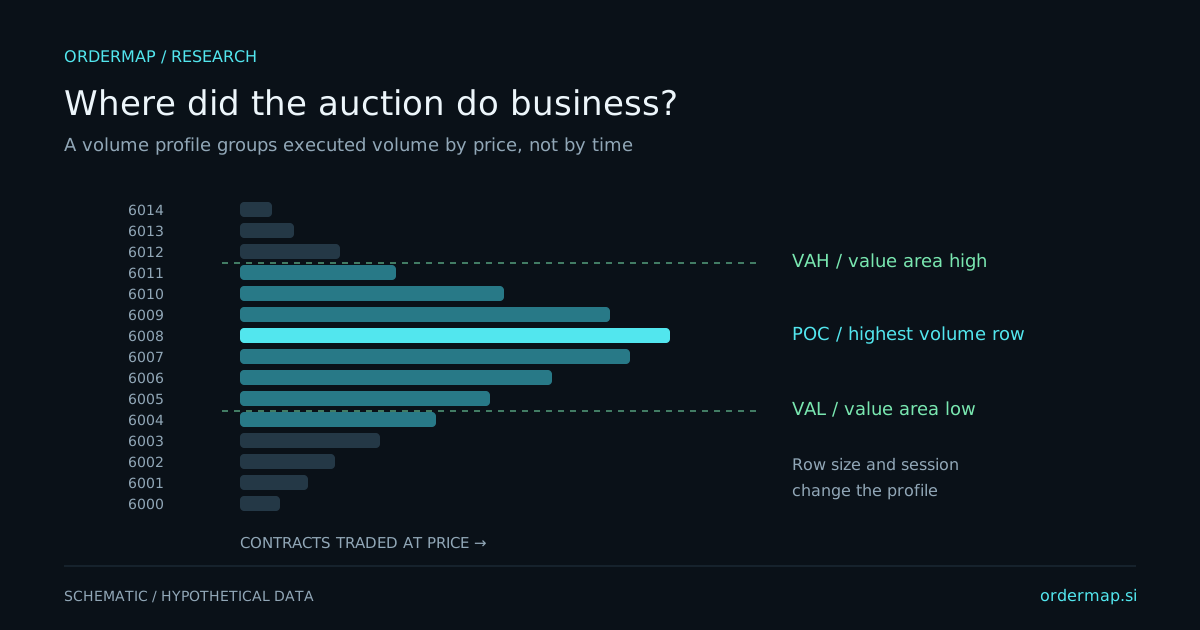
That control brings responsibility. You must implement state recovery, instrument identity, session boundaries and the calculations your product displays. A raw-data feed is not a precomputed GEX or footprint service merely because those products can ultimately be built from market observations. Evaluate the engineering effort alongside the data bill.
Specify time before choosing a provider
Record event time, receipt time and model observation time where they exist. A historical research job must distinguish what happened in the market from what your application could have known at a decision point. Later corrections can change the best available record without making the corrected value historically observable earlier.
For a hypothetical options dashboard, define whether the chain and underlying price must share an observation boundary. A current underlying beside an older chain can create an apparently precise exposure value from mismatched times. Preserve the mismatch or reject the calculation according to a documented policy; do not silently imply synchronization.
Test the failure contract and the license
Use small authorized requests to inspect pagination, rate limits, empty results and denied access. Confirm whether retrying a request is safe and whether an export is a bounded result or a long-running job. Do not infer product rights from technical access: display, storage and redistribution permissions need direct confirmation for your use case.
Estimate total effort with a concrete workload. A research notebook, a private dashboard and a customer-facing application have different request patterns and licensing requirements. Precomputed analytics may reduce maintenance, while raw data may be necessary for a proprietary method. Neither approach is automatically cheaper overall.
OrderMap offers a read-only REST, WebSocket and MCP API sharing domain calculations with its terminal. Developer subscriptions are separate, account quotas apply across keys, and historical access follows retention and actual coverage. Read API documentation, coverage and plans to evaluate it separately from this five-provider shortlist.
Choose one representative workload and implement the smallest useful prototype. Keep unavailable fields and time boundaries visible. The right API is the one whose contract you can maintain and explain when the data is imperfect.