Options Flow: Premium, Delta Notional, and Directional Ambiguity
Decode options prints without confusing premium with risk, call volume with bullish intent, or a large transaction with a complete investment thesis.
By OrderMap Research4 min read
On this page
A large print is a starting point
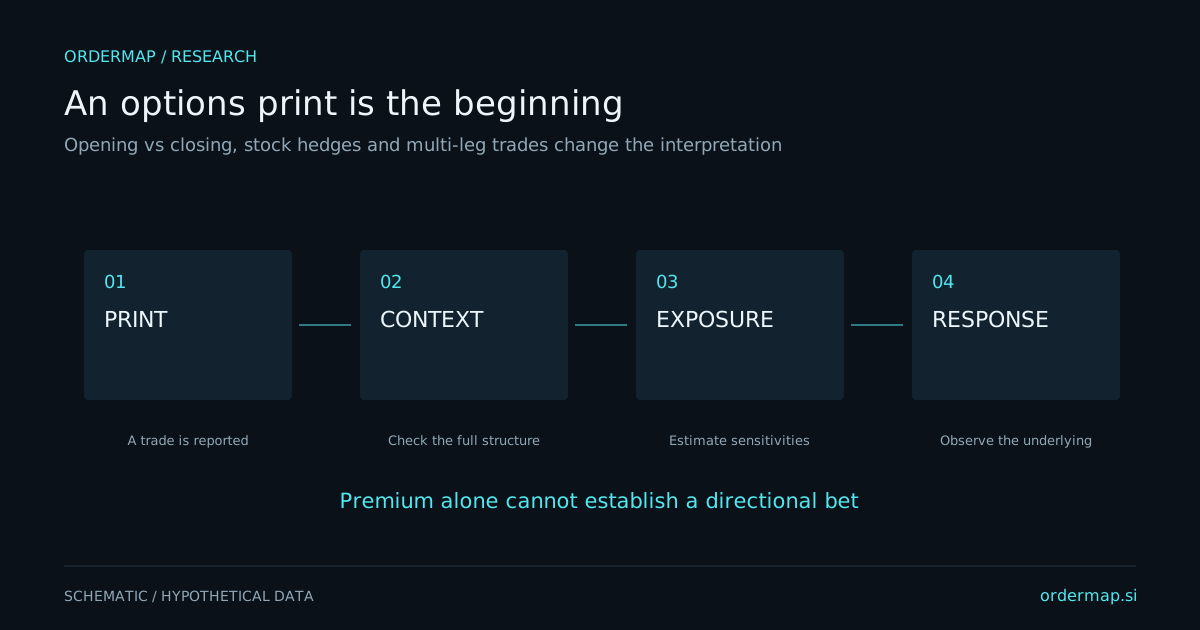
Options flow organizes transactions by contract, time, size, premium, and other available fields. It can reveal where activity is concentrated and how that activity changes. It does not automatically reveal why a participant traded, whether the transaction opens a position, or what other positions offset it.
A call transaction can be part of a bullish purchase, a covered-call sale, a spread, a closing trade, or a hedge. A put transaction can similarly express several different objectives. Treat the option type as a contract attribute before turning it into a sentiment label.
Premium and exposure use different arithmetic
Premium traded is option price times contract quantity times the contract multiplier. It describes the cash value exchanged for the option contracts under that calculation. Delta notional estimates directional sensitivity by multiplying delta, quantity, multiplier, and underlying price, with a position sign convention when available.
Assume an invented standard equity option with a 100-share multiplier: 1,000 calls trade at $2 while the stock is $100 and option delta is 0.30. Premium is $200,000. Unsigned call delta notional is $3,000,000. Neither number is the participant's total portfolio risk, and the print alone does not establish whether that participant is long or short.
| Measure | Hypothetical calculation | What it describes |
|---|---|---|
| Contract quantity | 1,000 | Number of contracts traded |
| Premium | 1,000 times 100 times $2 | Cash value of option contracts |
| Delta equivalents | 1,000 times 100 times 0.30 | Local share-equivalent sensitivity |
| Delta notional | 30,000 times $100 | Local directional dollar sensitivity |
Check contract specifications. Adjusted equity contracts, index options, and futures options may use different deliverables or multipliers. A hard-coded assumption that every option represents exactly 100 ordinary shares can create substantial errors.