Options Sweeps, Blocks, and Spreads: Read the Whole Transaction
Understand execution labels, why urgency does not establish informed direction, and how multi-leg packages can change the meaning of an options alert.
By OrderMap Research4 min read
On this page
An execution label describes a mechanism
An options alert labeled sweep, block, or multi-leg can be useful, but the label needs a definition. A vendor may infer a sweep from a cluster of prints across venues, while an exchange condition code may identify a specific order-handling mechanism. Those are different kinds of evidence.
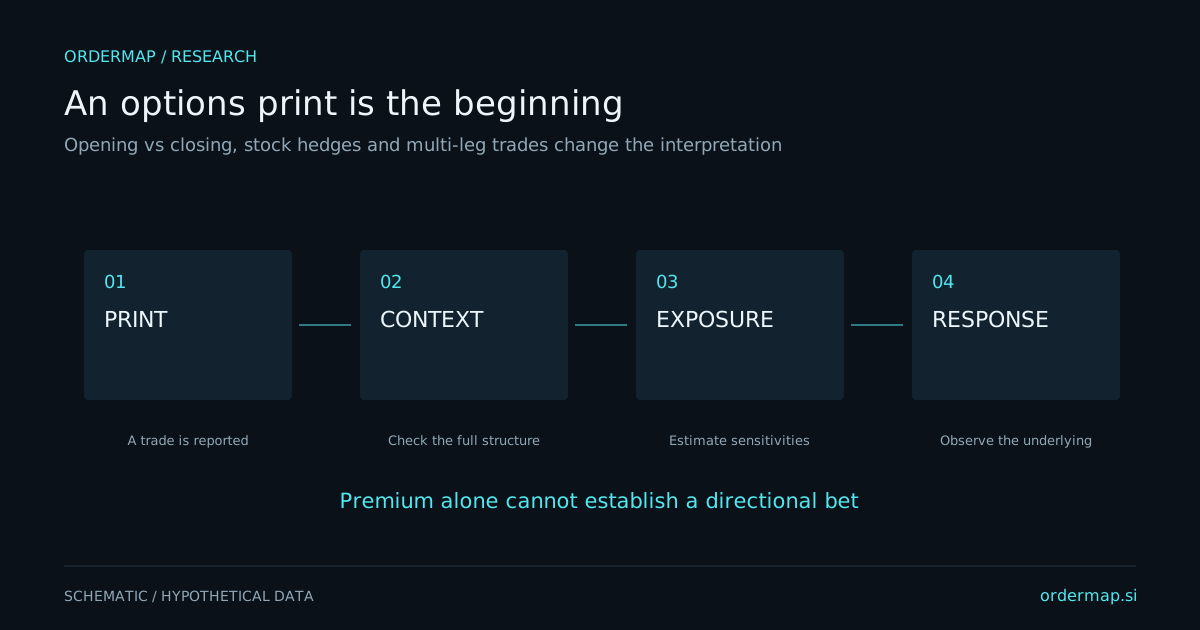
Do not assume a large print proves urgency, informed speculation, or an opening trade. A participant may be hedging a portfolio, rolling an existing position, reducing risk, or executing one part of a package. Transaction mechanics help describe how something traded; they do not reveal the entire economic objective.
Sweeps need a precise definition
At a high level, sweep language often refers to seeking available liquidity across multiple venues or price levels. The exact regulatory and exchange meaning of an intermarket sweep order is more specific than a retail alert's shorthand. Cboe's auction-process documentation describes one venue's Sweep & AIM handling and the interaction with better-priced interest.
A print cluster can support a hypothesis of related execution. It does not prove the participant knowingly paid any price to capture secret information. A hedge can be urgent too. Some routes and execution algorithms naturally create several smaller reports for one parent objective.
Record whether the classification comes from a direct condition code, exchange message, or timing-based inference. If the tool does not explain its method, treat the label as a convenience rather than a strong fact.
Size does not settle the block question
Retail flow products sometimes call any sufficiently large transaction a block. Exchange block-trade facilities have their own product-specific rules, thresholds, and reporting procedures. A large listed-options print should not automatically be described as using a formal block facility merely because its premium is large.