Absorption vs Exhaustion: Two Different Reasons a Move Stalls
Distinguish heavy aggression meeting passive liquidity from fading participation, and define the follow-through needed before calling a reversal.
By OrderMap Research4 min read
On this page
A stall does not identify its cause
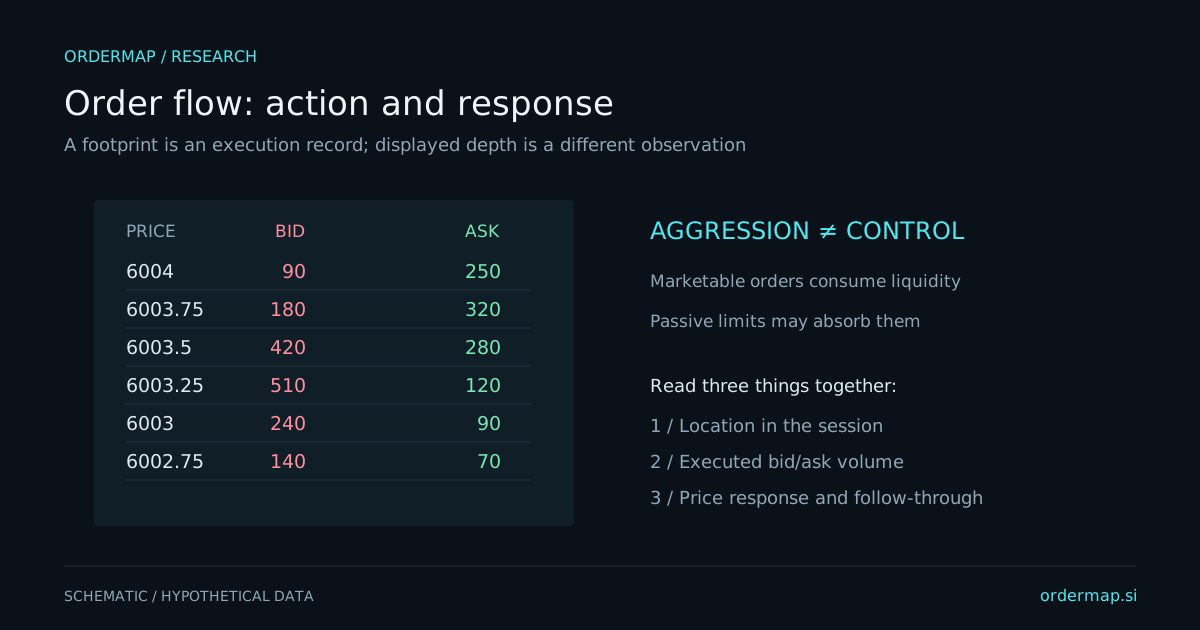
Traders often describe a failed advance as absorption or exhaustion. The words refer to different hypotheses. Absorption suggests substantial aggressive activity meeting enough opposing passive liquidity to limit price progress. Exhaustion suggests the aggressive side's activity is fading. A stall can contain both, neither, or a changing mix.
These are interpretations of observable transactions and liquidity, not verified identities or intentions. A footprint may show heavy ask-side activity at a high, but it cannot establish that one institution deliberately “trapped buyers.” Start by describing quantity, price progress, replenishment, and the next response.
Compare effort with result
Imagine an invented advance from 100 to 102. At 102, 2,000 contracts execute at the ask across several tests, but price cannot sustain a move above 102.25. That is high buying effort relative to modest upward progress. Passive selling may be meeting the buying. It remains possible that sellers eventually finish and the market breaks higher.
Now imagine a different advance. Each new high trades fewer contracts, the pace slows, and the last push above 102 prints little volume before falling back. That better fits an exhaustion hypothesis. Sparse trading does not guarantee reversal either: an illiquid market can continue higher with little quantity.
| Feature | Absorption candidate | Exhaustion candidate |
|---|---|---|
| Aggressive volume near extreme | Substantial relative to context | Fading relative to prior pushes |
| Price progress | Limited despite effort | Limited as participation slows |
| Book behavior | Opposing size may replenish | May show little persistent opposition |
| Main uncertainty | Will passive liquidity survive? | Will aggression return? |
| Useful next observation | Break, hold, or failed retest | Renewed participation or rejection |