Top 5 GEX Products in 2026: A Workflow-Based Shortlist
Compare five documented gamma exposure products by research workflow, model questions and evaluation tasks rather than unsupported accuracy rankings.
By OrderMap Research··4 min read
On this page
The best GEX product for a trader is the one whose model, coverage and presentation fit the question being asked. A futures trader mapping an index reference, an equity trader scanning many names and an options researcher comparing expirations can reasonably choose different tools.
This October 19, 2026 shortlist contains five documented offerings. The numbered order reflects editorial workflow fit, beginning with specialized index research and widening toward broader positioning workflows. It is not a market-share table, a model-accuracy ranking or a performance test. OrderMap publishes this article and has a commercial interest in options analytics; the list is a publisher's buying guide, not an independent award.
SpotGamma is a useful starting candidate if SPX options influence is central to your day. TRACE's documented model perspectives make it important to learn what each view measures rather than treating every display as a generic gamma wall.
Separate price, volatility, and time effects on option delta, and use vanna and charm estimates without turning them into automatic flow forecasts.
·4 min read
For evaluation, select one reference before the session and save its observation time. Write what you expect to learn when price reaches that region. If you cannot explain the distinction between a model concentration and actual execution evidence, spend the trial learning the framework before adding more indicators.
Quant Data belongs on a shortlist organized around chain slices. Its documented strike and expiration views support an evaluation that starts with scope: a single expiry, a selected set, or the broader chain.
Use the same underlying and timestamp while changing one expiry filter. Record how much the apparent concentration changes. This drill helps reveal whether the attractive headline total is actually the quantity relevant to your trading horizon. It also discourages comparing two providers with different chain selections and calling the resulting disagreement an accuracy test.
MenthorQ's published coverage and update guide makes it a candidate for readers whose first constraint is a specific asset or time window. Treat the schedule as something to inspect for the exact product you intend to use; do not assume every model updates on the same timetable.
During a trial, check the model before your normal preparation time, again near your decision window and after the session. An otherwise useful level can be operationally unsuitable if you need an observation before it becomes available. Coverage and timing should precede opinions about chart appearance.
Unusual Whales is worth inspecting if you want Greek exposure alongside a wider options-research routine. Its explanation of OI and Greek updates is particularly relevant because an intraday recalculation and a new open-interest observation are different events.
Ask which variable changed when a gamma plot moved. Was it spot, volatility, time, the position assumption or a new source observation? A refreshing screen does not imply that every underlying input refreshed. That distinction belongs in any serious comparison of what traders call live GEX.
GammaEdge's public offering combines positioning tools with expiry selection and screening. It is a reasonable candidate for a trader who wants to organize a watchlist around an options-structure framework.
Evaluate whether the framework produces a research plan you can explain independently of the platform's labels. Save a candidate, the chosen horizon and the conditions that would remove it from your watchlist. A screening tool should narrow investigation; it should not turn a proprietary label into an unquestioned directional conclusion.
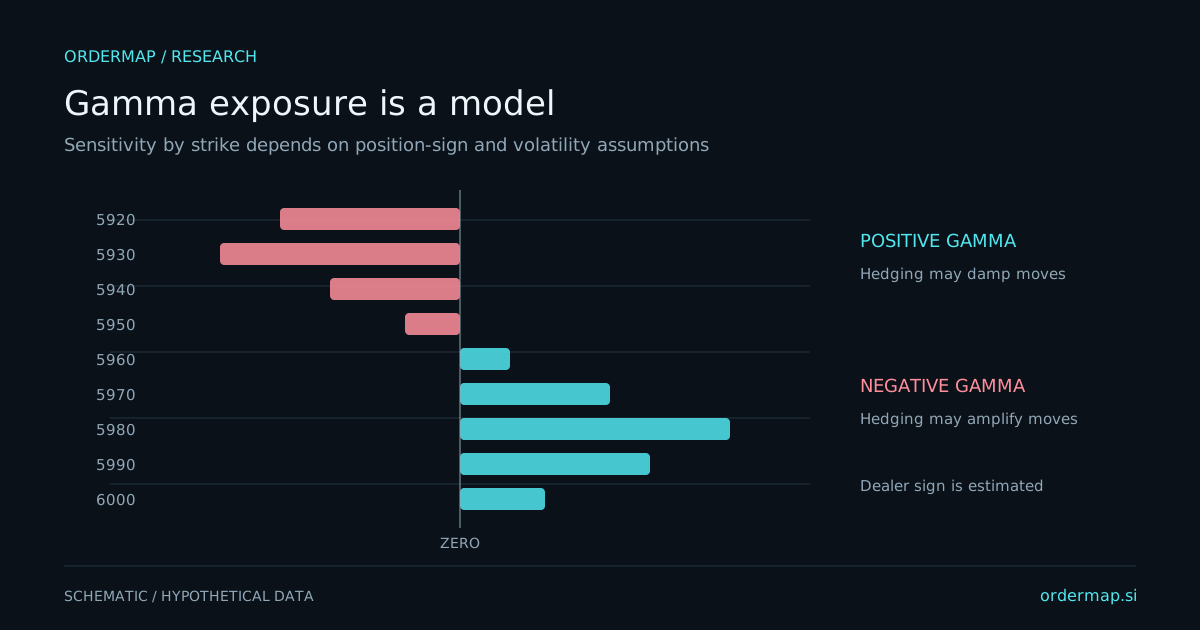
Conceptual GEX map only. It does not display observed dealer holdings, live market data or ranked vendor results.
For each finalist, record underlying coverage, expiry scope, units, input times and the positioning assumption. Ask whether historical views preserve what was observable then or recalculate the past using later information. These questions are more informative than demanding identical levels across products.
Suppose one model highlights a concentration near an invented index level of 6,000 and another highlights 6,025. First match units and expiry filters. Then investigate input times and assumptions. If the difference persists, retain it as model uncertainty instead of selecting whichever line price subsequently respected.
When mapping an index reference onto a future, store the dated contract and contemporaneous basis. A copied strike is not automatically the right futures price. Separate the options model from the futures observation you use to study acceptance, rejection or continued movement.
OrderMap combines exposure and options-flow analysis with futures footprints, executed profiles and captured liquidity. That connection may be useful when your process explicitly moves from an options reference to a futures auction question. We have not inserted OrderMap into this five-product list as though this publication were an independent review of itself.
Inspect OrderMap's options offering, platform and plans separately. Confirm the actual instrument, session and entitlement coverage. Models are conditional estimates, and retained views cannot supply an unlimited history of observations.
Choose two finalists, use one written research task and preserve the evidence that would invalidate your interpretation. A useful GEX subscription makes uncertainty easier to manage; it does not remove it.